

During my third year in high school, one of my favourite teachers introduced us to a book by Henri Nouwen, the Return of the Prodigal Son. The author's reflections revolve around the Biblical story and Rembrandt's painting of the prodigal son, his father and the elder brother. The book's premise is that each of us has elements of the younger son, the elder son and the father, but ultimately we are called to be like the father - compassionate, forgiving and generous.

The younger son said to his father, "Father, let me have the share of the estate that will come to me.
The younger son's story is about leaving home, demanding and squandering his inheritance and returning to his father. Leaving home is about "a denial of the spiritual reality that I belong to God with every part of my being, that God holds me safe in an eternal embrace, that I am indeed carved in the palms of God's hands and hidden in their shadows." How often do we leave our home in the Lord? According to Nouwen, some of the signs that we have left home include anger, resentment, jealousy, a desire for revenge, lust, greed, antagonisms and rivalries.
Leaving home is about seeking affirmation, rewards and praise with an empty and hungry heart; it is about choosing to ignore His gentle and quiet voice in favour of the worldly noise and pomp. I am a naturally competitive person, and too often I feel the need to prove my worth and to show my capabilities. I think about playing to win and coming out on top. However, in doing so, I forget that my self-worth lies not in my achievements but in accepting my place in the Lord's home. I squander the talents, skills and resources that I have been blessed with and realize that I have done so in vain, which in turn continues to leave me with an empty and hungry heart.
But remember, the younger son returns to his father too. It is a journey back to the Lord to receive forgiveness, which "requires a total willingness to let God be God and do all the healing, restoring and renewing." Now I need to ask, "Do I truly want to be so forgiven that a completely new way of living becomes possible? Do I want to break away from my deep-rooted rebellion against God and surrender myself so absolutely to God's love that a new person can emerge?"
Leaving home is about seeking affirmation, rewards and praise with an empty and hungry heart; it is about choosing to ignore His gentle and quiet voice in favour of the worldly noise and pomp. I am a naturally competitive person, and too often I feel the need to prove my worth and to show my capabilities. I think about playing to win and coming out on top. However, in doing so, I forget that my self-worth lies not in my achievements but in accepting my place in the Lord's home. I squander the talents, skills and resources that I have been blessed with and realize that I have done so in vain, which in turn continues to leave me with an empty and hungry heart.
But remember, the younger son returns to his father too. It is a journey back to the Lord to receive forgiveness, which "requires a total willingness to let God be God and do all the healing, restoring and renewing." Now I need to ask, "Do I truly want to be so forgiven that a completely new way of living becomes possible? Do I want to break away from my deep-rooted rebellion against God and surrender myself so absolutely to God's love that a new person can emerge?"
"All these years I have slaved for you and never once disobeyed any orders of yours, yet you never offered me so much as a kid for me to celebrate with my friends. But, for this son of yours, when he comes back after swallowing up your property - he and his loose women - you kill the calf we had been fattening."
We often focus on the younger son in the Biblical story and how we can relate to him. However, we must also remember the elder son and his part in the story. As the eldest child in the family, I can certainly relate to his resentment. Nouwen counts condemnation of self and others, self-righteousness and self-rejection as elements of the elder son's lostness, even if he had stayed at home and obeyed his father. He writes that "returning home from a lustful escapade is much easier than returning home from cold anger that has rooted itself in the deepest corners of my being."
I remember always striving to be the dutiful daughter - stick to the rules, behave in class, take home good grades and medals, bring the family honour and pride. I also remember resenting how my parents used to let my brothers and sister get away for breaking rules, getting called into the principal's office and showing bad grades at the end of term. I remember carrying grudges against my siblings for not living up to what I believed were the right standards of living and to not taking the seemingly conventional path to success. I carried similar resentment for peers and colleagues who seemingly have an easier and unconventional road to success.
The Biblical account remains open-ended on the story of the elder son. To this day, I still struggle more with the elder son in me. How do I find my way into my Father's embrace? How do I welcome back the younger son with as much joy, compassion and forgiveness as the Father? How do I trust in the Father's all-forgiving and welcoming love?
The father said to his servants, "Quick! Bring out the best robe and put it on him; put a ring on his finger and sandals on his feet. Bring the calf we have been fattening, and kill it; we will celebrate by having a feast, because this son of mine was dead and has come back to life; he was lost and is found." And they began to celebrate.
Nouwen asks himself, "Do I want to be like the father? Do I want to be not just the one who is being forgiven, but also the one who forgives; not just the one who is being welcomed home, but also the one who welcomes home; not just the one who receives compassion, but the one who offers it as well?" A friend told him, "You have been looking for friends all your life; you have been craving for affection as long as I've known you; you have been interested in thousands of things; you have been begging for attention, appreciation, and affirmation left and right. The time has come to claim your true vocation - to be a father who can welcome his children home without asking them any questions and without wanting anything from them in return. Look at the father in the painting and you will know who you are called to be... We need you to be a father who can claim for himself the authority of true compassion."
As a parent, I am slowly appreciating this call to be like the Father in compassion, forgiveness and generosity. As a mother, I have had my heart broken during the many times I wish I could shield my son from pain, sickness and sadness. My patience is constantly being tested by my now strong-willed toddler. The majority of my resources are now being channeled into my children's inheritance. However, I realize this is not enough. I still challenge myself on whether I am truly becoming the mother I am supposed to become, whether I am painting a good example to my son and soon-to-be daughter, whether I am fulfilling my duties as a wife and whether I am prepared to give and receive unconditional love. I am still haunted by desires reminiscent of the younger son and plagued by resentment and self-righteousness so much like the elder son.
How do I become like the Father?
Be compassionate as your Father is compassionate.
When in doubt, go black and white.


I dread visiting dentists. Once I start to open my mouth for their routine inspection, I am on the receiving end of tut-tuts, pity, annoyance, advice and a combination of some and all of these. Each and every time, I think to myself,
"Yes, I know my teeth are horribly crooked. Yes, I know I need braces. Yes, I know I need to do something about it."
I grew up with two working parents and four siblings in a modest household. We had everything we needed but not much for luxury, which I thought was fine on most days. Braces were out of the question - it would eat up too much of our family budget. Being the eldest daughter, I took this fact in stride and accepted that until I started earning my own money, my teeth would need to take a backseat.
As a child and teenager, I also accepted the fact that I could never be "beautiful." My notion of beauty at the time was perfection - perfect hair, perfect smile, perfect skin, perfect body. I had neither, as I had bushy hair, horrible teeth, pimply dark skin and a plump body. From then on, I worked hard on the one thing I considered my greatest asset - my brains. At the very least, I could achieve perfect grades when I wanted to. I graduated with the highest honours and landed a scholarship at my dream university.
I consider myself lucky that I got into relationships with partners who accepted all of me, including my imperfect smile. They appreciated my intelligence as much as my so-called beauty. I never experienced being forced to conform to alleged standards of beauty and perfection - they always let me be myself, including the good, the bad and the ugly.
Today, I am blessed with a husband who never once criticized my crooked smile. I have a husband who tells me he loves his beautiful and intelligent wife. Half the time, I greatly appreciate the part where he tells me he loves my brains. Half the time, I secretly wish I could accept the part about my beauty. It's still hard for me to fully accept; I still feel like an ugly duckling.
Last weekend, we paid a visit to a new dentist for teeth cleaning. My last appointment with a dentist was around three years ago. I made a fuss and got into a quarrel with my husband who did not want to be late for our appointment. He didn't know I was stalling and dreading that visit.
I braced myself for the tut-tuts, pity, annoyance, advice and a combination of some and all of these when she started to inspect my teeth. I waited. And waited. And waited. It never came. Instead, she commended me for good oral hygiene, given that she did not need to clean out my teeth so much. When I brought up the topic of braces, she first asked me if I thought there was a problem with my teeth.
That was the first time a dentist has ever posed that question to me.
"Do you have a problem with your teeth? Because I don't want the problem statement to come from me. It has to come from you. Who am I to state a problem which you don't consider a problem?"
Bluntly, I stated the obvious.
Again, for the first time ever, a dentist told me that while my teeth need work to be straightened out, she also told me that at the very least, my "profile" (i.e. the proportion from forehead to chin and from mouth to jawline) was fine. She advised that the only way to conclusively say braces could help me with my problem was to undergo an x-ray examination.

Needless to say, I walked out of that clinic feeling an extreme sense of relief and gratitude.
"What would you give for your art, David?""I'd give my life."
"When the sun comes up, you'll get your wish. After that, if you like what I've given you, you'll have 200 days to use it - before you die."
On a sunny Sunday morning, my husband and I came across Scott McCloud's The Sculptor on the bestsellers' shelf at our favourite bookstore. Neil Gaiman is quoted on the cover, saying it is "the best graphic novel I've read in years." No dispute there.
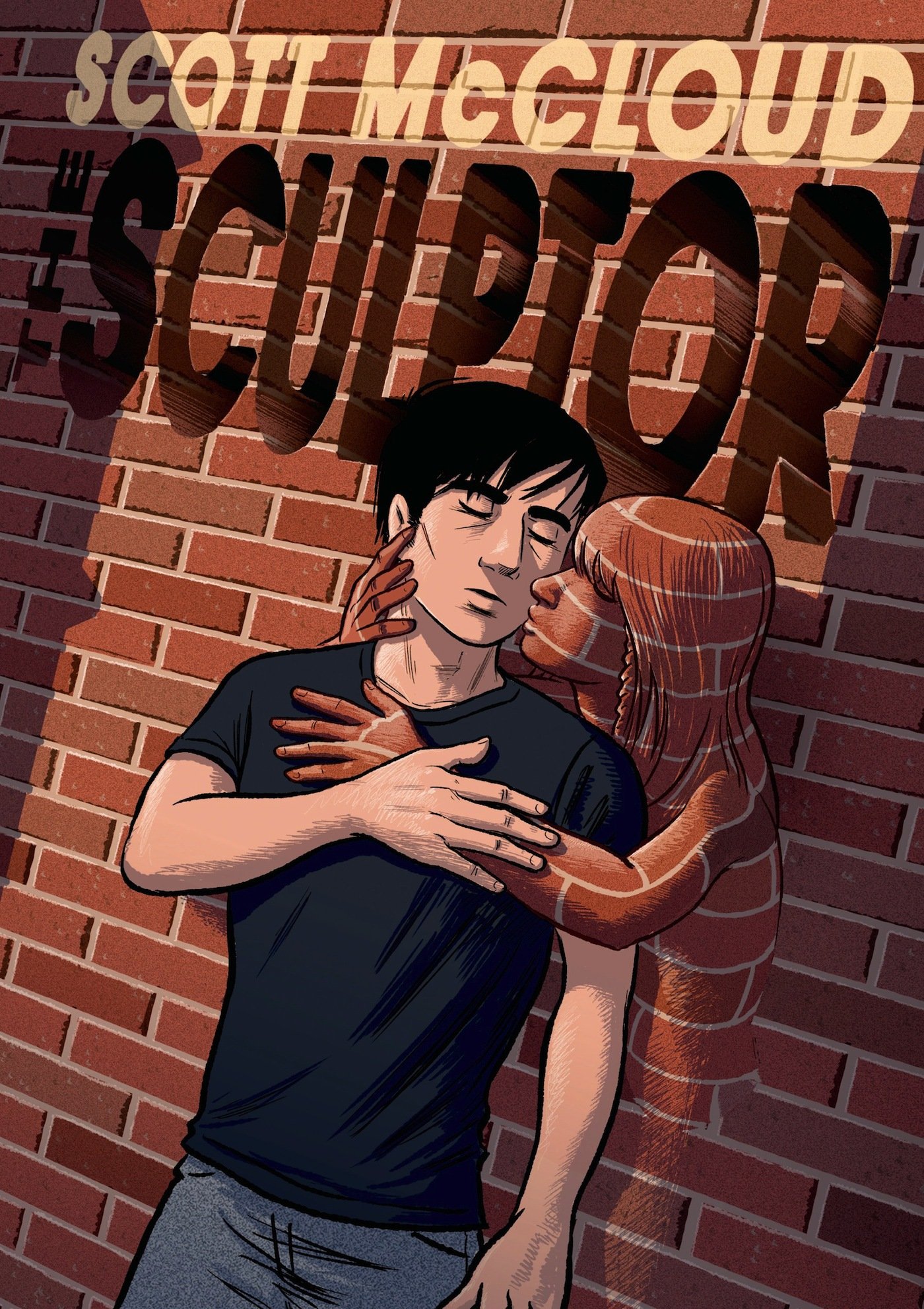
The plot seems simple enough - hopeless boy is visited by long-dead uncle who grants his wish of having the power to become an unprecedented artist on the condition that after 200 days he dies. Boy struggles with his art, meets girl through unconventional circumstances, falls in love, and realizes what matters most in this life. It is the beauty of the artwork and the wit in the dialogue that makes this seemingly simple story such a riveting and heartwarming read. I finished it in one afternoon but interpreted the lines and scenes so many ways over a period of so many days.
"Tell me a secret. Something you've never told anyone. Tell me softly even that moth can't hear. After you're gone, I'll carry it inside of me. I'll think of it every day. But when I'm gone, the secret goes with me. Together, we'll let it die, just you and me. Not 'cause we're helpless in the face of time, but because we're giving ourselves to time with all our hearts."
We spend most of our time chasing the things we think matter - money, fame, career, recognition, legacy. We tend to forget how limited our time on this Earth is. We struggle with our choices. We tell ourselves tomorrow will be better, that we can catch up with life someday. Then, we wake up and realize that that someday was yesterday and that today is almost over. We get to the point of no return and scramble to make up for lost time. And just like that, they're gone. We're gone. Time is up.
We must choose. When we do not choose, we still choose.
I ask myself this question when choosing becomes difficult - if Death is at my doorstep ready to collect my soul, can I tell myself that I am ready to go? Have I made choices that leave me with a sense of contentment and peace, or am I filled with regret and remorse?